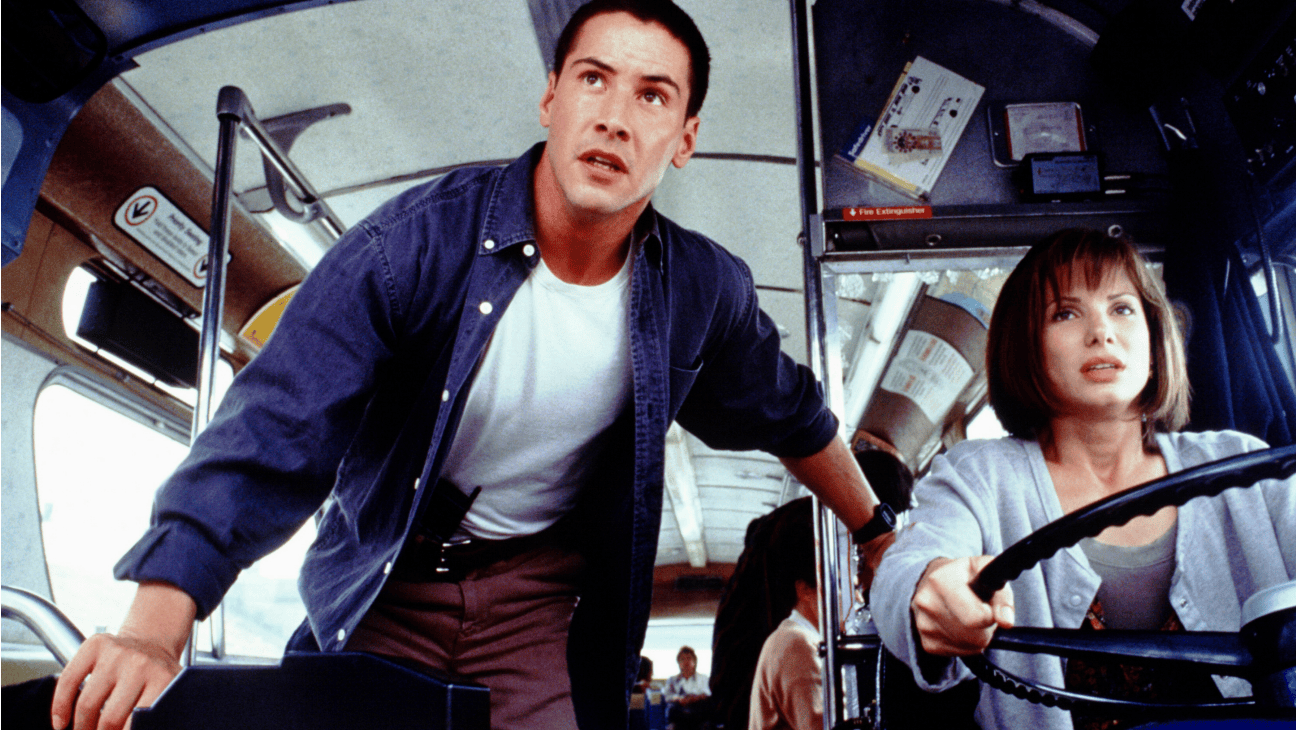
It’s hard to believe that in the year of our lord 2026, I hadn’t seen the original “it’s Speed but on a <train/airplane/blimp/roller coaster/pontoon” movie, but I just missed it when it first arrived in 1994. I’ve always known that it was a silly action movie that launched the careers of Sandra Bullock and a post-teenager movies Keanu Reeves, but I don’t think I knew just how silly it was.
But before we get to all that: Pop Quiz, Hot Shot: What passes for the “plot” of this classic film?
A Brief Synopsis of ‘Speed’: What if the guy from ‘Dumb & Dumber’ and Ted from ‘Bill & Ted’s Excellent Adventure’ had to outsmart the real life insane person that was Dennis Hopper? That’s the jumping off point this cinematic thriller as it begins with generic business people in a generic office building wrapping up a generic business meeting (that probably could have been an email) and heading for the elevator…as a group…like a bunch of fucking psychos. What business? Doesn’t matter. What building? Who cares. What are their names? Their names in the credits range the gamut from “Young Executive” all the way to “Female Executive” so they’re basically props. While this varied group of go-getters are ALL TOGETHER IN THE ELEVATOR (which again, is psychotic behavior. If everyone from a meeting I was in crowded into the same elevator, at the same time, I would assume we were all about to die). Meanwhile, Dennis Hopper (who’s motivation won’t be fully explained until much, much later in the film) stabs a security guard in the temple and overrides the elevator controls in the basement. He’s gonna blow up the elevator unless somebody pays him money not to blow it up, but also he’s crazy but really he’s just Dennis Hopper holding a movie hostage for a check.
Luckily for the elevator coworkers, and the movie, Keanu Reeves is here to save the day (even though he doesn’t seem to understand how bombs or physics work) and he’s brought Jeff Daniels for comedic relief! The two intrepid cops stop the bomber (or do they?) and end up the heroes. But this has all actually just strengthened Dennis Hopper’s villain origin story and led him to his opus work. His masterpiece. His Mona Lisa. A bomb on a bus…that can’t slow down…or it’ll explode.
See, that’s the whole raison d’être for the film: bus goes fast, bus keeps going fast, bus eventually explodes. Simple, efficient, totally 90s.
So some time passes and Keanu wants a coffee and pastry for his break…..KA-BOOM! A random bus explodes in Keanu’s neighborhood with a driver he knows at the wheel. Just then, a payphone rings across the street (note: yes, all payphones did have return call numbers at this point in history. Payphones were prevalent in society before communication got hijacked by big corporations, much like Dennis Hopper and a bus…but I digress). Keanu must find a bus that Hopper’s planted a bomb on and follow the rules or everyone dies and none of it can stop until he gets his money.
From there on out, it’s a pretty standard action flick which is why the pitch “It’s ‘Speed’ but on a <blank>” dominated the box office for a few years after it’s success. The bus is populated with a standardly diverse cast of characters including:
Man who believes the cops are there for him! (they’re not)
Kind-hearted bus driver who’s there to add to the stakes! (he’s been shot…but no one can leave the bus!)
Old couple who only have each other hold onto during this ordeal! (they don’t speak much, but they’re in love)
Big tough guy who’s there to give Keanu props for being even tougher than him! (and make an obligatory “Big Balls” joke)
Cameron from “Ferris Bueller’s Day Off” playing Cameron from “Ferris Bueller’s Day Off”
Sandra Bullock as the replacement bus driving love interest who gives the movie heart and even MORE stakes
While he does eventually get everyone off the bus by safely driving the bus around the tarmac at an airport only to somewhat intentionally crash into a 747 (bus and plane go BOOM!), the action doesn’t stop there as the LAPD continue to make bad choices with their handoff of Hopper’s money (which had been motivating his revenge against the cops brain for the entire movie because he didn’t get the pension of deserved and was still a little spicy about it).
Hopper grabs the cash and Sandra and heads into the bowels of an ad for the LA Subway. The trains are empty, clean and fast but OH MY GOD! the track isn’t finished. With one last flourish, Keanu dispatches Hopper’s head, saves Bullock and puts another city project completion behind by crashing onto Hollywood Boulevard for the big finish.
The girl is saved, the bus is gone and Hopper’s lost his head and all in less than 2 hours. But he still blew up Jeff Daniels and nobody seems to mourn him so why should we?
Why is it a Pop Culture Blind Spot?‘‘Speed’ was a cultural phenomenon that I just plain missed. My summer of 1994 was spent in a much more ‘The Lion King’ with my first girlfriend kind of headspace. Also, I was 14 and had religious parents so the sheer IDEA of asking to see an R-rated movie in the theaters was completely and utterly out of the question. The first R-rated movie I’d see at the Regal Cinemas in Fredericksburg, VA wouldn’t be until 2 years later when I happened to run into my Aunt Bobbie and Uncle Bill in line as I was trying to buy a ticket for ‘The Rock’ (she vouched for my ticket so I could get in, a favor I would never forget). But that summer, ‘Speed’ was everywhere! Not only did it launch the career of Sandra Bullock into the stratosphere but it showed that the weird teenager from ‘Parenthood’ was truly an action-ish star. Long before he would become Neo in ‘The Matrix’, Keanu was that cop on a runaway bus. ‘Speed’ bled into the zeitgeist with famous lines (“Pop quiz, hot shot!), great reviews and set the tone for action movies in the 90s. It built on the legacy of high velocity scripts, one liners and cool guys who didn’t look at explosions. It was the quintessential 90s popcorn action flick…and then they put the sequel on a boat.
How does it look in the rear view mirror? Pretty good actually. Much better than I thought it would. Are there some goofy moments where it seems like they’re just trying to put as many manufactured obstacles in front of the bus as possible? Sure. Is it weird that Cameron from “Ferris Bueller” doesn’t suggest that they just drive the bus backwards to try and get rid of the bomb? Of course. But at the end of the day, ‘Speed’ gives you exactly what its title promised: fast-paced action that feels like drinking too much caffeine and then trying to write your name in cursive without shaking.
Final Thoughts: Everyone should see ‘Speed’ at some point in their life if for no other reason than historical context. ‘Speed’ came to a California stop so that “The Fast & the Furious” series could drive it off a cliff…towards a plane…in space.
They'd like you to know that although they're from different California cities, they are now together and in "full effect"
Let’s begin with a simple, known truth: I am the last person that should be writing about G-funk rap music. I grew up in the South, in the middle of the country part of the suburbs. I am fundamentally unqualified to say anything about the quality or s***ness of any rap album, much less an album that’s won multiple Grammys, been ranked #6 on the Vibe 100 Essential Albums of the 20th Century, the 137th Greatest Album of All Time by Rolling Stone or won a mother f***ing Grammy. Also, I may not have been in the right state of mind to listen to this album the 10 or 11 times that I did.* Honestly, of all the things that I’ve approached as Pop Culture Blind Spots, this one has been the most f****** daunting. There are so many potential pitfalls in reviewing something that’s so revered by so many g** d*** people. It’s definitely the biggest task that I’ve taken on since I originally declared ‘Top Gun’ a s*** movie that’s one step below porn. When ‘The Chronic’ was recorded in June of 1992, LA was just coming to grips with the 1992 LA riots that brought absolute chaos to the streets of the city of Angels. The country as a whole was still trying to process what had brought Los Angeles over the f***** edge of absolute chaos (spoiler alert: you can’t let cops beat spmeone up on video tape and then escape prosecution and expect everyone to be ok with that) and that December Dr. Dre’s ‘The Chronic’ sprung into the mainstream with a vengeance. Before we talk about the actual content of the album, I feel like I need to issue a couple of disclaimers:
Is the album homophobic? Completely. Dre, Snoop and the others on the album constantly use implied homosexuality as a way to infer that their enemies are somehow immediately less than them. At the end of “F*** wit Dre”, Snoop actually lists out all of the people that he doesn’t like who can s*** a fat d***. I’m not in any way condoning that kind of language anymore than I’m condoning that the best way to deal with those who dis you is to shoot them in the head. Both are wrong but that’s not the point of this post.
Does the album constantly use a word that I’m uncomfortable with? F*** yes. And it’s not the F word. I’m not even going to say which word it is because as comedian Louis C.K. points out as soon as I call it out, I’m actually forcing your brain to say the word in your head which is actually just passing the terrible swearing baton to you instead of me. Let me just say that I’m not comfortable with anyone using the word but I support Dr. Dre and the others using the word if they’re comfortable with it.
A Brief Synopsis of ‘The Chronic’: After a conflict with the other members of N.W.A. in 1991, Dr. Dre left the group and began producing his first solo album ‘The Chronic’. It’s largely considered to be the album that popularized the G-funk style of West Coast rap with it’s slowed down grooves, incorporation of P-funk (re: George Clinton) melodies and incredibly creepily off-kilter f***** synthesizers. Even now in 2011, I could play a few of the synthesizer riffs from ‘The Chronic’ and they’d be immediately recognizable as pieces of Dr. Dre hits. It’s an album that deals with everything from the party pieces of the West Coast Gangsta lifestyle. It’s an album that makes drastic swings from the comedic (on tracks like ‘ The $20 Sack Pyramid’) to the very tragic (with songs like ‘Lil’ Ghetto Boy’). It’s less a declaration of war on the status quo than a condemnation of it. The three singles ‘Nuthin’ but a “G” Thang’, ‘F*** wit Dre’ and ‘Let Me Ride’ (which all went at least Gold) speak to different aspects of life on the LA streets. One of the best descriptions of ‘The Chronic’ that I’ve read pointed out that it portrays the gangsta lifestyle as a non-stop party that’s sometimes interrupted by gunfire. There’s really no better description of what ‘The Chronic’ serves up. It’s all about the b*****s and weed until the s*** hits the fan and then somebody’s got to go all 187 on somebody else. Also, in the g** d*** middle of it all there’s more than one extended flute solo and a few comedy sketches. It’s a testament to the difficulty of life on the streets of LA at that time when everyone had to make a choice between life on the sidelines or a life that straddled the line between true honesty and crime. It’s really unlike any other album I’ve heard and that’s a very, very good thing. It’s also the album that brought the phrase “Deez Nuts” into the mainstream. So that’s gotta be worth something.
Why is it a PCBS? Really? You’re reading this f***** blog and you’ve never f***** heard of ‘The Chronic’? Outside of the accolades detailed above, ‘The Chronic’ was named one of the Top 10 Rap Albums of All Time by Vibe, one of the top 100 rap albums of all time by Spin and the third greatest hip hop album of all time by MTV. Outside of establishing Dr. Dre as a solo artist it also launched the careers of Snoop Doggy Dogg, Nate Dogg and Warren G among others. ‘Nuthin but a “G” Thang” is still considered one of the greatest hip hop songs of all time and has been ruined more than a few times by g** d*** idiots at karaoke bars all across the world. Outside of all of these culturally important reasons that it’s a PCBS, there’s a few more personal reasons that this album falls into the PCBS wheel house. When I think back to music videos that hypnotized me in the summer of 1993, I’m able to remember the video Dr. Dre’s ‘Nuthin But a “G” Thang’. Harken back to those glory days of MTV when they showed videos and felt the need to blur out corporate logos that might appear in them. ‘Nuthin but a “G” Thang’ is one of those videos that you just never f***** forget. From the haunting synth at the beginning of the track to the crazy house party atmosphere that leads Snoop to declare that “it’s like this and like that and like this and uh”, it’s one of those tracks that stays with you forever.
How does it look in the rear view mirror? Honestly, it all looks a bit odd. Since they burst onto the scene in ‘The Chronic’, Dr. Dre and Snoop Dogg have steadily become less social rebels and more and more mainstream. Snoop Dogg will basically guest on anyone’s track for the right price these days (e.g. Pussy Cat Dolls) and he and Dr. Dre have both become spokesmen for high end products from Pepsi Max to Dre’s own line of premium mother f****** headphones. Listening to these corporate pitchmen rap about how hard life is on the streets is a little hollow but you have to remember that it was recorded almost 20 years ago. The world has changed and Dre and Snoop have managed to successfully changed with it. Ignoring all of that, it’s hard to deny that ‘The Chronic’ wasn’t a f***** blueprint for rap for most of the 90’s and early 2000’s. Since then Dre, Snoop, Warren G and and Nate Dogg have all had success on their own and the roots of rap in 2011 can mostly be traced back to the West Coast movement started by Dr. Dre and ‘The Chronic’. There’s something more interesting that’s come up while listening to ‘The Chronic’ and that’s the idea of an f***** album as a form of protest. In my mind, the greatest example of an album created simply to give someone the finger is Marvin Gaye’s ‘Here, My Dear’ created in response to his wife’s court win requiring him to pay her the residuals from his next album. It’s an album that is soaked in a mix of remorse and disdain. It’s very clear from the beginning that it’s clearly aimed to make someone uncomfortable while also selling albums. To me, that’s the way ‘The Chronic’ feels. It’s an album that’s as much a rebellion against N.W.A. (and specifically Easy E) as it is a chance to showcase the Death Row Records funky a** artists.
Final Thoughts: When it’s all said and done, it would have been much easier for me to say that I didn’t like ‘The Chronic’. But with catchy hooks, a strong social message about the state of LA in 1992 and the seeds for all of the hardcore rap that I’ve loved in the ensuing two decades, it would be a bit disingenuous for me to say that I’m not a huge fan of ‘The Chronic’. A few weeks ago, on my other blog, I wrote about the comfort of continuity and how a continuing story makes every individual episode that much more enjoyable. For me, listening to ‘The Chronic’ is like reading the prequel to the 90’s and early 2000’s. ‘The Chronic’ laid the groundwork for everything from Warren G’s ‘Regulate’ to Chris Rock’s ‘Roll With the New’. Do I approve of all the imagery that Dr. Dre and his friends use on the album? No. Do I think they’re a bit homophobic and misogynistic? Of course. But at the end of the day, they do make me put my hands in the air and wave them around as if I just don’t care. Plus, Snoop is credited with the creation of the word “bootylicious” on this album (although he uses it as a slur against another rapper) and that leads to an awesome Destiny’s Child single years later so you have to support that. Word to the mother f***** streets.
*meaning I was not super, duper high when listening to ‘The Chronic’. Seriously, there’s a part of me that thinks this album would BLOW MY MIND if I were super, crunk ass high when listening to it but let’s face it: I’m 30 years old and that’s just g** d*** f***** irresponsible, you stupid b****.
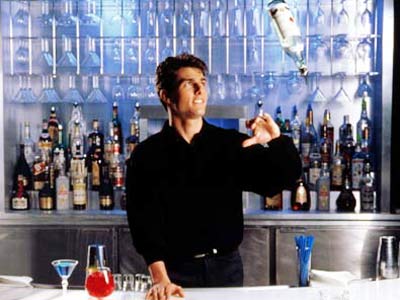
Before he asked us to show him the money, before he told us that we couldn’t handle the truth and before he went crazy because there were aliens inside him that only a dead science fiction writer knew how to control, Tom Cruise threw a bottle of liquor in the air and it was magical. In another Pop Culture Defense, let’s take a look back at Mr. Cruise at the height of his power, ready to take on the world and impregnate Elisabeth Shue in ‘Cocktail’.
You could argue that ‘Cocktail’ is just a Jerry Bruckheimer movie that wasn’t produced by Jerry Bruckheimer (a mistake he’d correct by basically remaking the movie 12 years later in the form of ‘Coyote Ugly’). It has all the hallmarks of a non-explosive Bruckheimer flick: coming of age story with a good looking protagonist who overcomes their blue collar background to make it in the big bad world with built in pop song markers to help convey the tone along the way. But ‘Cocktail’ rises above it’s pay grade with clever writing, great over-the-top performances by it’s three leads and characters that make you want to drop it all and become a bartender…or a bar tender groupie. It’s more philosophical than ‘The Matrix’ and soapier than ‘You’ve Got Mail’ but in the end it manages to become one of my favorite late 80’s/early 90’s movies about bartending.
A Brief Synopsis of ‘Cocktail’: For not explainable reason, ‘Cocktail’ opens with Brian Flannigan (Tom Cruise) flying down the road in a jeep full of dudes trying to catch a bus to New York City (as Starship sings ‘Wild Again’, their contribution to the movie’s iconic soundtrack). Young Mr. Flannigan, having just left military service, is off to seek his fortune in the big city but soon finds that he’s not qualified for anything since he’s got absolutely zero work experience. Dejected after days of rejection, he decides to try business school and falls ass backwards into a job as a bartender alongside Doug Coughlin (played by the other Australian actor from the 80’s, Bryan Brown). Brian’s first night behind the bar is tough as waitresses dressed in TGIFriday’s outfits and sterotypical New York bar patrons scream drink orders at him (Do you know what’s in a Cuba Libre?) but he’s determined to have it all and decides to stick with bartending while still attempting to get a degree in business. We’re treated to a few quick scenes as Brian learns the difference between book smarts (like an assignment to write his own obituary….clever) and street smarts (Doug’s cavalcade of bar tricks and slights of hand). Doug’s lessons are a bit more than just suggestions. No, Doug lives by a series of “Couglin’s Laws” which amount to nothing more than the regurgitations of someone who’s spent a lifetime behind a bar and an afternoon or two in the back of a Philosophy 101 class. As Brian’s skills improve, we get those indelible shots of Doug and Brian behind the bar mixing drinks in tandem while flipping bottles back and forth between each other and dancing to “Hippy Hippy Shake”. It’s nothing if not incredibly charming. Books and actual learning put up a good fight but in the end, Doug and Brian find their ticket to the big time when one of their patrons offers them a job at “The Hottest Bar in New York City”. The boys jump at the chance to leave their local watering shit hole bar and work someplace with a velvet rope and every starving model within a 32 block radius. The bar includes everything you’d expect from a late 80’s NYC hot spot: huge bar, gorgeous people and weird poetry from both patrons and bartenders. It’s at this fancy beat poetry joint that the two meet up with the surest sign that any movie is about to get bat-shit crazy: Gina Gershon. Let me stop here and say that I don’t in any way dislike Gina Gershon. In fact, I think she’s a fantastic character actress who brings a certain something to absolutely every role she enters. But…if you’re just watching a movie one day and suddenly, out of nowhere and without warning, Gina Gershon comes on screen you can be certain that things are about to get weird. Gina Gershon, of “Bound”, “Face/Off” and lest we forget “Showgirls” fame is like the harbinger of bonkers. For God’s sake, the woman showed up on “Cop Rock”. How can that not be some kind of fascinatingly weird resume that deserves a special kind of respect? Regardless, Gina Gershon shows up as Coral, a photographer who manages to expose the distance between Brian and Doug with a single flash of her camera. Brian and Coral start dating (and by dating I mean sleeping together) and soon Doug begins to get jealous. But before things can completely implode, the guys discuss their hopes and dreams over a few breakfasts with Coral. Both of the guys want to someday own a bar (which Doug decides should be called ‘Cocktails & Dreams’ which is about as subtle as the bar in “Leaving Las Vegas” being called ‘The Whole Year Inn”) and Brian pitches the idea of going to Jamaica to earn the money to eventually buy a place in New York. Doug’s not much for the idea of “jet-set bartenders”, though. While playing basketball in the park a few days later (as you’ll do), Doug bets Brian that he can get Coral to leave him by the end of the weekend (as you’ll do). All it takes is for Doug to tell Coral that Brian’s been spilling secrets about their wild romps in the sack and she’s out the door like a shot. It’s the final straw and Brian decks Doug right into their fancy bar set up. Fade to black. But soon the scene fades up on a sunny Jamaican resort (while “Kokomo” by the Beach Boys plays) where Brian’s taken up a bartending gig. With the help of a bit too much booze and definitely too much sun, Brian has to ride to the rescue of Jordan Mooney (because ‘Moneybags McWealthypants’ would have been too obvious a name). Jordan’s an artist and waitress from New York who’s vacationing for an undetermined amount of time with her parents in Jamaica and is played by everybody’s favorite babysitter, Elisabeth Shue. Brian and Jordan start montaging together and soon are in 80’s movie love (walks on the beach, late night dancing in a beach club, ‘Blue Lagoon’-esque sexy time under a waterfall) but trouble lurks just around the corner. Doug shows up in Jamaica (with his new super hot, super rich wife in tow) and manages to get Brian to cheat on Jordan in less than 24 hours. Once again, the boys decide to bet on something classy. This time it’s Brian’s ability to close the deal with a cougar at the end of the bar named Bonnie. Jordan (of course) sees Brian leaving the bar with Bonnie at the end of the evening and flies home to New York City that very night (because that’s plausible). The next day, Brian discovers he’s been found out and decides that the best way to deal with the situation is to fly back to New York with Bonnie and become her bitch. She’s promised him that she’ll reward his puppy dog loyalty by giving him a sweet job at the company she runs but seems to only use that as a carrot to make Brian take her to art openings and get her, well, carrot juice. It’s at one of these art openings that Brian finally snaps and storms off, leaving Bonnie and determined to regain some semblance of his manhood. He hunts down Jordan and finds out two important pieces of information: 1) she’s loaded (as in with rich parents) and 2) she’s loaded (as in with baby). Brian’s determined to prove that he wants to be with Jordan (as long as nobody bets him to sleep with anyone else) but her dad is determined to make sure that Baby and baby stay in the corner. He offers to buy Brian off with $10,000 but (in a fit of 80’s movie self righteousness) Brian rips up the check and once again declares his love for Jordan…who’s not having any of it. Aimless, Brian seeks out Doug who’s parlayed his rich wife into his own nightclub, yacht and expensive glassware (wait, oh no). But once they’re alone, Doug reveals to Brian that it’s all a lie and that he’s not got “a pot to piss in”. He’s kept it a secret from his wife and drinks basically a whole bottle of liquor in a few gulps so Brian does the only responsible thing and leaves him alone with his thoughts and sharp objects. At her request, Brian takes Doug’s wife Kerry home where she uses the old “let’s talk about my husband’s problems upstairs” trick to try and get Brian in the sack. Thankfully, as if to prove that Brian now has some sort of moral compass, Brian refuses to sleep with his best friend’s wife and instead goes back to the yacht to check on Doug (not that there’s anything to worry about, cause ol’ Dougy is fine). Upon reaching the boat, he finds Doug in a pool of his own blood and it’s pretty obvious that he’s chosen to off himself. Brian responds with the appropriate level of screechy/screamy agony and…Fade to Black. After Doug’s funeral, Brian receives a letter from Doug (which is odd since Doug didn’t know Brian was back from Jamaica and back in New York, but whatever) explaining that he killed himself because he could no longer face the lie of a life that he’d created for himself. It’s just the push that Young Flannigan needs to once again purse Jordan (and her Mooney). He bursts past the doorman, flies into her parent’s apartment and screams out for her. There’s a brief “we didn’t have time to hire a fight coordinator” scuffle between Brian and Jordan’s father but in the end Jordan willingly leaves with Brian…even though his next infidelity is a mere bar bet away. The movie closes with Brian (now the owner of his own local shit hole bar called ‘Cocktails & Dreams’) climbing up onto the bar for one more poem about his unborn children. It’s at this point that Cruise begins to slip into his super terrible Irish accent (something that returns in “Far & Away”) and Jordan reveals that it’s not one baby, its twins! Because what’s better than one kid that a new small business owner can’t afford? Two kids! Roll credits.
Why is it a Pop Culture Defense? ‘Cocktail’ is a landmark movie for the simple reason that it’s all things to all people. Want a buddy movie? Check out ‘Cocktail’ for the complicated yet touching story of a boy and his bartender. Want a complicated romantic tale of young love? Check out ‘Cocktail’ for its overly soapy story of a boy and the girl he knocks up while on vacation. Want a ridiculously over-the-top movie that celebrates all of the excesses of the 80’s? Check out ‘Cocktail’ with it’s yuppies and Gina “I always look like the cat that just swallowed the canary” Gershon. Want a musical? Check out ‘Cocktail’ which is not only the movie that brought us dancing while bartending but is also the movie that introduced the world to ‘Kokomo’ (possibly one of the worst pop songs of all time) AND ‘Don’t Worry Be Happy’ by Bobby McFerrin (definitely one of the worst pop songs of all time). It’s the kind of movie that everyone could go see and enjoy for completely different reasons. Some people enjoyed watching Tom Cruise on a journey of self discovery that took him from the streets of New York to the beaches of Jamaica and back again. Others enjoyed watching Elisabeth Shue take her top off. See, something for everyone. It’s a not so serious movie that dealt with a lot of pretty serious topics like unwed pregnancy, alcoholism, suicide and Gina Gershon. But really, the movie achieves almost a cult like status for one reason: it’s made everyone try to flip a bottle of booze like that at least once. Admit it. At some point in your life, you’ve grabbed a bottle of something and attempted to flip it either in the air or behind your back. Most likely, you’ve done it with a bottle that was sealed and most likely you’ve failed, but you’ve tried it. That motion, that desire to see if you could try to pull of an amazing bar trick can be directly attributed in one way or another to the movie ‘Cocktail’ and for a cheesy 80’s movie, that’s saying something.
How does it look in the rear view mirror? Honestly? It looks insane. But add a little Vaseline to that mirror and you get a much happier, blurrier, tipsier view of a movie that struck at the height of the Tom Cruise craze. It’s sometimes hard to remember that Tom Cruise really did use to be the biggest star on the planet. ‘Cocktail’ comes in the middle of a stretch of five movies that solidified Tom as the absolute biggest star on Earth. He made ‘Top Gun’ (hate it), then ‘The Color of Money’ (love it), followed by ‘Cocktail’ (defending it right now), then ‘Rain Man’ (good movie, definitely a good movie) and finally ‘Born on the 4th of July’ all in the span of three years. Those are Micheal Jordan repeat championships caliber stats. Can you even think of another actor in the last 20 years who’s had a run of movies that big and that generally good in that amount of time? Before you say Julia Roberts or Will Smith, I say ‘Dying Young’ and ‘Wild, Wild West’. ‘Cocktail’ is literally lightning in a bottle. It’s Cruise’s star power, confidence and charisma that take something that should be awful (or at best adequate) and make it into something really special. Want proof? Check out this very simple scene from ‘Cocktail’ where Tom Cruise uses his newly found bartending skills to hit on a woman dressed as a muppet:
Seriously, that’s the guy movie equivalent of a scene with the main character singing into her hairbrush into the mirror but somehow, it all comes off as completely endearing. For me, performances like this are like a magic trick. It’s as if he’s using slight of hand to confound and distract us from the general shakiness of the movie around him. Kid goes from not bartending one day to fancy show-off bartending in the span of a few 80’s songs? Sure. Kid moves to Jamaica to tend bar at a resort only to meet and impregnate the true love of his life? Of course. Wise, truth telling older guide turns out to be incredibly dark “there but for the grace of God goes Flannigan” warning for the main character? Why the hell not! It’s all just window dressing and yet somehow it all works like a charm. You never even see how they manage to saw the lady in half and put her back together before you’re clapping wildly, ready for the next trick.
Final Thoughts: What’s the last piece of the puzzle to make any movie an almost instant classic? Quotable lines. And luckily, ‘Cocktail’ has more than a few that resonate in the lexicon. Whether you’re looking for one of Coughlin’s laws (“never tell tales about a woman, she’ll hear you no matter how far away she is” or “anything else is always something better”) or one of the “poems” Young Flannigan improvs while standing on the bar (my personal favorite being “I make drinks so sweet and snazzy / The iced tea / The kamakazi” simply because no matter how hard he tries snazzy and kamakazi don’t rhyme), the movie is full of lines that are just begging to be repeated in the proper situations. Couple that with a simple action that everyone wanted to try and repeat (like the dance that Uma Thurman does in “Pulp Fiction”) and a soundtrack that unleashed some terrible things on the world and you have a classic movie that’s very deserving of a Pop Culture Defense. ‘Cocktail’ stands the test of time with it’s brash attitude that dares you not to like it. Give it a try the next time you flip past it on a Saturday afternoon. Just don’t blame me when you’re singing Kokomo for the rest of the weekend. It’s a high price to pay, but it’s definitely worth it.